Anker Prime 27,650 mAh Review: The 250 W Power Bank That Charges Your MacBook
Anker Prime 27,650 mAh review: 99.36 Wh airline-legal power bank, 250 W total output, 140 W USB-C PD. Where it beats the Anker 737 and whether 250 W output is overkill.
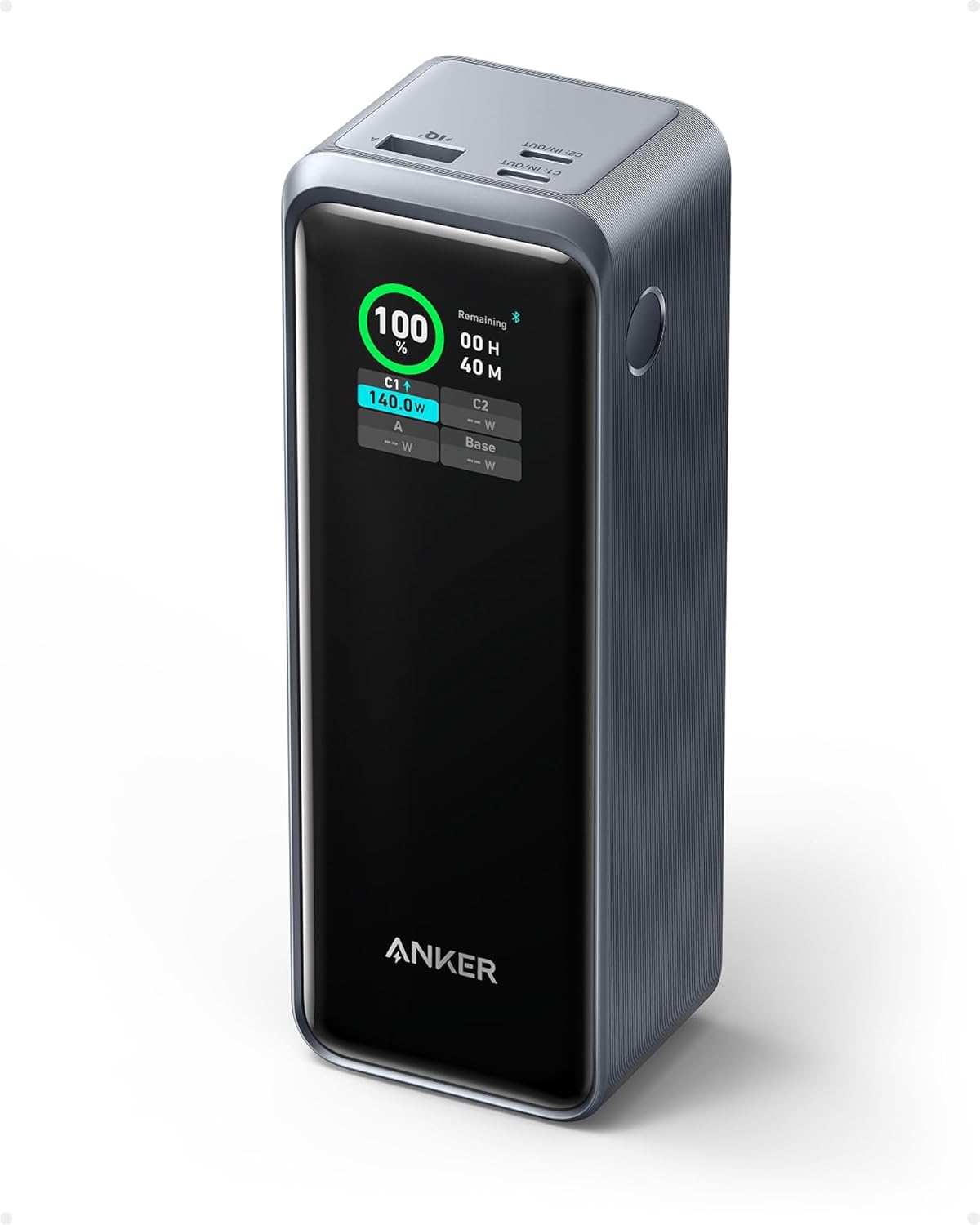
The Anker Prime 27,650 mAh sits at the absolute ceiling of what a power bank can be without crossing the 100 Wh FAA airline carry-on limit. 99.36 Wh of energy, 250 W of combined output, and a 140 W USB-C port that actually fast-charges modern laptops — this is the power bank you buy when you want to leave the laptop charger at home.
This review covers where the Prime 27,650 wins for laptop-on-the-road users, where the cheaper Anker 737 wins on cost, and whether 250 W of total output actually changes anything for most buyers.
What it is, in one sentence
A 27,650 mAh / 99.36 Wh airline-legal power bank with 250 W of total output, 140 W USB-C fast charging, and a smart color display showing capacity, output wattage, and time-to-full/empty in real time.
Specifications
| Spec | Prime 27,650 Anker, $179 |
|---|---|
| Capacity (mAh) | 27,650 mAh |
| Capacity (Wh) | 99.36 Wh (under 100 Wh airline limit) |
| Battery chemistry | Lithium-Ion (Li-Ion) |
| Total output | 250 W max across all ports |
| USB-C 1 output | 140 W PD 3.1 |
| USB-C 2 output | 100 W PD |
| USB-A output | 65 W (10 W if other ports active) |
| Input | 140 W USB-C PD |
| Recharge time (140 W input) | 1.25 hours to 100% |
| Smart display | Color LCD: mAh, W, time, temperature |
| Pass-through charging | Yes (charges devices while recharging) |
| Airline carry-on legal | Yes (FAA limit is 100 Wh) |
| Weight | 1.36 lb / 617 g |
| Dimensions | 5.9 × 2.0 × 2.0 in |
| Warranty | 2 years (extended to 30 months with registration) |
| MultiProtect certifications | 12 safety + thermal protections |
Where it wins
99.36 Wh hits the FAA airline limit on the nose
This is the headline spec. The FAA limits lithium-ion power banks in carry-on luggage to 100 Wh — anything over that requires airline approval for up to 160 Wh, or is banned outright above that. The Prime 27,650 lands at 99.36 Wh, deliberately engineered to maximize capacity without crossing the line. The Anker 737 is 96 Wh; smaller banks in the 18,000-20,000 mAh range are 65-75 Wh. For travelers maximizing carry-on power, the Prime is at the ceiling.
140 W USB-C fast-charges a 16-inch MacBook Pro
The Prime 27,650’s lead USB-C port delivers 140 W PD 3.1 — the spec required to fully fast-charge a 16-inch MacBook Pro M3 Max (140 W charger needed for max speed). The Anker 737 caps at 100 W on its main port, limiting MacBook Pro charging to standard speed. For travelers who want to leave the MacBook charger at home and still get a full top-up in under an hour, the Prime is the only power bank in this size class that does it.
A 14-inch MacBook Pro (96 W charger) charges to 100% from empty in about 90 minutes via the Prime. The Prime itself has enough capacity to fully recharge the 14-inch MacBook Pro 1.5× from empty.
250 W total output for power-hungry desk setups
When you split the load across all three ports, the Prime delivers up to 250 W combined. Real-world scenarios: 140 W to a MacBook Pro + 65 W to an iPad + 30 W to a phone, all simultaneously. The Anker 737 caps at 140 W total. For a digital nomad running a multi-device setup off battery, the headroom matters.
Smart display shows what’s actually happening
The Prime’s color LCD shows real-time output watts per port, remaining mAh, estimated time-to-empty (based on current draw), input watts, and internal temperature. The Anker 737 has a similar display; the cheaper 20K-class banks have a simple percentage indicator. For users who want to verify their laptop is actually drawing 140 W (and not throttling), the Prime’s per-port wattage display is genuinely useful diagnostic information.
1.25-hour self-recharge via 140 W input
The Prime accepts 140 W of input via USB-C PD, recharging itself from 0% to 100% in about 75 minutes. Most competitors in this capacity class take 2-3 hours. For a same-day turnaround (deplane, recharge in lounge, fly out fully topped up), the Prime is one of the few options that fits in a layover.
Where it loses
1.36 lb is real weight
The Prime weighs 617 g (1.36 lb). The Anker 737 weighs 22.4 oz (635 g — slightly heavier actually). 20,000 mAh competitors weigh 380-450 g. For backpack-only travelers, the extra ~200 g over a smaller bank is noticeable on a long day. For laptop bag carriers, it’s a non-issue.
$179 MSRP, double a 20,000 mAh bank
The Prime 27,650 lists at $179, often $149 on sale. A 20,000 mAh / 100 W bank from Anker (the 737 was $149 at launch but has since become harder to find) or competitors typically sells for $70-$90. The Prime’s premium buys you 50% more capacity and 40% more output — justified for laptop charging, overkill for phone-only use.
Bundled charger sometimes optional
Some Prime 27,650 SKUs ship with a 100 W ChargerCharger (a USB-C wall brick) bundled; others sell the bank standalone. For full 140 W recharge speed you need a 140 W USB-C charger — those run $59-$79 separately from Anker. Check the SKU before buying.
No wireless charging
Some travel power banks in this price range include MagSafe-style wireless charging pads on top. The Prime 27,650 is pure wired only. For users who want a single device that handles phone + laptop, a separate MagSafe bank may make more sense.
Anker Prime 27,650 vs the alternatives
| Spec | Prime 27,650 Anker, $179 | 737 (24,000 mAh) Anker, $149 | Prime 20K Anker, $129 |
|---|---|---|---|
| Capacity (mAh) | 27,650 | 24,000 | 20,000 |
| Capacity (Wh) | 99.36 Wh | 86.4 Wh | 72 Wh |
| Airline carry-on (<100 Wh) | Yes | Yes | Yes |
| Lead USB-C output | 140 W | 100 W | 100 W |
| Total output | 250 W | 140 W | 200 W |
| Number of ports | 3 (2× USB-C, 1× USB-A) | 3 (2× USB-C, 1× USB-A) | 3 (2× USB-C, 1× USB-A) |
| Input speed | 140 W | 60 W | 100 W |
| Smart display | Color LCD | Color LCD | Color LCD |
| Weight | 617 g | 635 g | 450 g |
| Street price | ~$149 | ~$119 | ~$99 |
Who should buy it
- MacBook Pro travelers (16-inch or 14-inch) wanting laptop-class charging without packing a laptop charger.
- Multi-device digital nomads running laptop + tablet + phone simultaneously.
- Frequent fliers maximizing carry-on power. 99.36 Wh is the airline-legal ceiling.
- iPad Pro M-series users who want full 30-45 W fast charging from a power bank.
- Anyone who values diagnostic info — the per-port watt readout is genuinely useful.
Who should skip it
- Phone-only users. A 20,000 mAh bank from Anker or competitors does the job for $70 less.
- Budget travelers under $100. The Anker Prime 20K at $99 covers laptop charging at lower speed for less money.
- Wireless charging users. Buy a MagSafe-compatible bank instead.
- Anyone who already owns the Anker 737. The upgrade is real but marginal unless you specifically need 140 W output.
Frequently asked questions
Anker Prime 27,650 mAh FAQ
Is the Anker Prime 27,650 actually allowed on planes?
Yes, in carry-on luggage only. The FAA limits lithium-ion power banks to 100 Wh in carry-on (the Prime is 99.36 Wh, just under the line) and prohibits them in checked baggage. International airlines follow similar IATA rules. Always pack power banks in carry-on, not checked bags. The 99.36 Wh capacity is clearly printed on the case for security screening.
Can the Prime 27,650 fully charge a 16-inch MacBook Pro?
Almost. A 16-inch MacBook Pro has a 100 Wh battery; the Prime delivers 99.36 Wh stored, but conversion losses (~10-15%) mean you'll get roughly 85-90% of one full MacBook Pro charge from empty to full. For a 14-inch MacBook Pro (70 Wh battery), the Prime delivers 1.4-1.5 full charges from empty.
What's the difference between 140 W and 100 W USB-C output?
140 W is the maximum output spec in USB-C PD 3.1, introduced in 2021. It's required to fast-charge the 16-inch MacBook Pro at full speed (Apple's bundled charger is 140 W). 100 W is the older PD 3.0 limit and is sufficient for most laptops, including 14-inch MacBook Pro, ThinkPad X1 Carbon, and Dell XPS 13. If your laptop's bundled charger is rated under 100 W, you don't need the 140 W output; if it's 140 W (16-inch MacBook Pro), you do.
Can I charge the Prime while it charges my devices?
Yes — pass-through charging works. Plug the Prime into a wall outlet via 140 W input, and plug a laptop into one of its output ports. The bank prioritizes input power: the laptop charges at full speed, and any leftover input wattage tops up the Prime's internal battery. This is the recommended usage pattern in hotel rooms — the Prime acts as a multi-port USB-C charger when grid-tied, and a power bank when unplugged.
Why is the smart display useful?
Real-time wattage per port tells you whether your laptop is actually drawing 140 W (full speed) or throttling to 60 W due to a cable limit, port issue, or laptop thermal throttling. Time-to-empty estimates help you decide whether to find a wall outlet or keep using battery. Internal temperature warns you if the bank is getting too hot in a hot car or direct sunlight (Li-Ion ages faster above 95°F). For diagnostic and operational use, the display earns its keep.
Bottom line
The Anker Prime 27,650 mAh is the best 100 Wh airline-legal power bank for buyers who travel with a laptop. The 140 W USB-C output is the only spec in this capacity class that fully fast-charges a 16-inch MacBook Pro, and the 99.36 Wh capacity sits exactly at the FAA carry-on ceiling.
If your laptop charger is 100 W or lower, the cheaper Anker 737 covers the same use case for $30 less. If you only need to charge phones and tablets, a 20,000 mAh bank does the job for half the price. For laptop-class power on the road, the Prime 27,650 is the rational pick.
Editor’s rating: 4.5 / 5
Last reviewed: May 2026. Pricing accurate at last check; verify on merchant page.