Champion 8500 W TRIFUEL Generator Review: Whole-Home Backup with Wireless Remote Start
Champion 8500 W TRIFUEL review: gas/propane/natural gas, 6,750 W rated, electric + wireless remote start, 50-state CARB. The most flexible whole-home portable generator under $2,500.
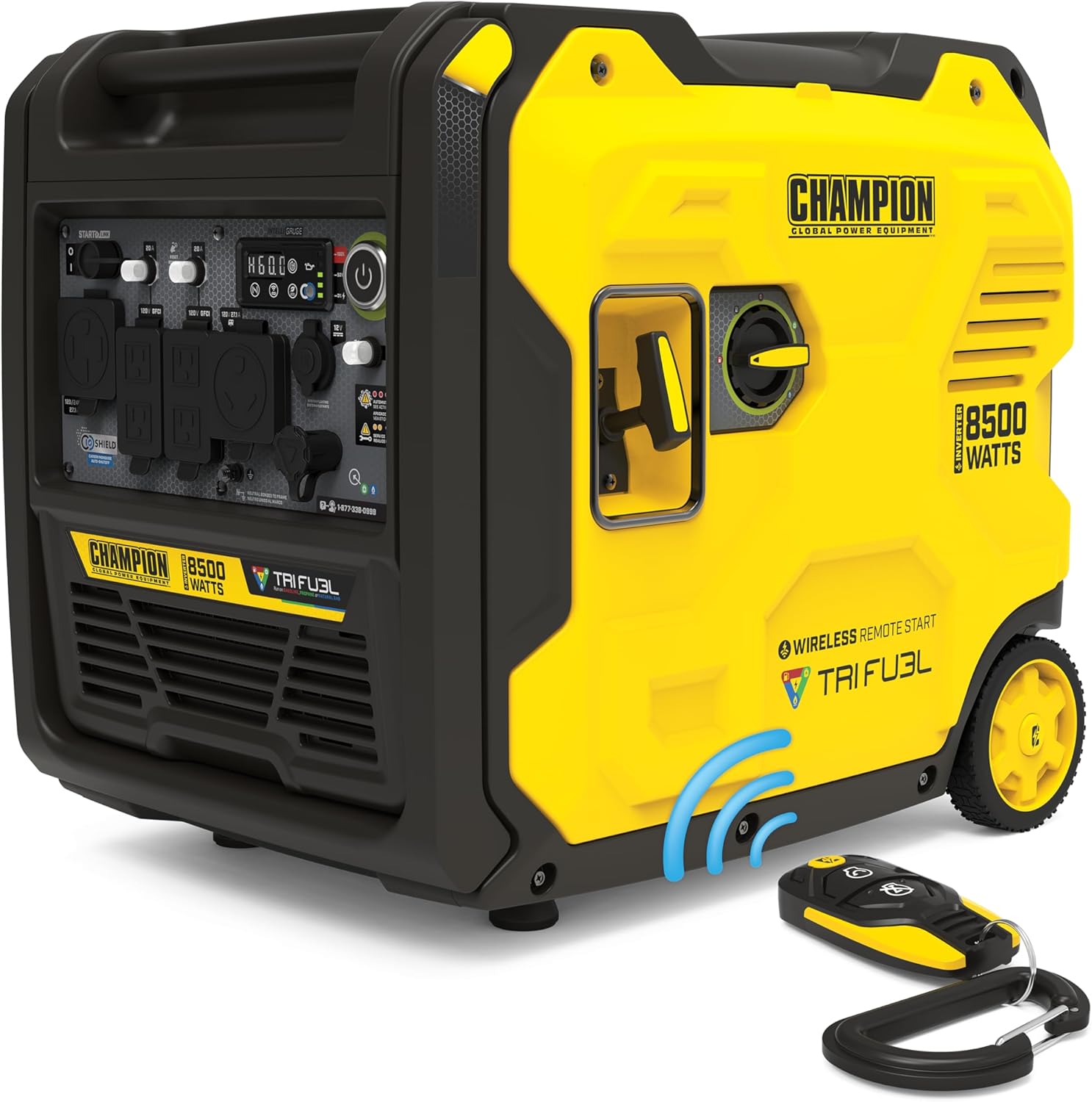
The Champion 8,500 W TRIFUEL is the whole-home backup generator that solves the fuel-availability problem most generators ignore. Gasoline is cheap and available — until it isn’t (post-hurricane fuel shortages are real). Propane stores indefinitely but limits runtime to the tank. Natural gas runs indefinitely off your home’s existing supply but isn’t available everywhere. The Champion 8500W TRIFUEL runs all three, and lets you switch fuels in the field as availability changes.
This review covers where the tri-fuel + wireless remote architecture matters for serious home backup, where the open-frame design pays acoustic and waveform penalties versus inverter generators, and how it compares to permanent standby alternatives at this price.
What it is, in one sentence
An 8,500 W starting / 6,750 W rated open-frame portable generator that runs on gasoline, propane, OR natural gas, includes wireless remote start, outputs 240 V split-phase for hardwired home backup, and costs roughly half the price of a permanent standby generator.
Specifications
| Spec | 8500W TRIFUEL Champion, $2,199 |
|---|---|
| Starting wattage (gas) | 8,500 W |
| Running wattage (gas) | 6,750 W |
| Starting wattage (propane) | 7,650 W |
| Running wattage (propane) | 6,075 W |
| Natural gas (starting / running) | 7,225 W / 5,737 W |
| Engine | 459 cc OHV 4-stroke |
| Start methods | Wireless remote + electric + recoil backup |
| Fuel type | Tri-fuel: gasoline + propane + natural gas |
| Gas tank | 4.7 gallons |
| Runtime at 50% (gas) | ~9 hours |
| Runtime on 20-lb propane (50%) | ~5.5 hours |
| Noise level | ~74 dBA at 23 ft |
| Outlets | 1 × L14-30R 240V 30A, 1 × 14-50R 240V 50A, 4 × 120V 20A, 1 × 12V DC |
| 240 V split-phase | Yes (built-in) |
| Output waveform | Open frame (not pure sine — higher THD) |
| CARB compliant | Yes (50-state) |
| Weight | ~200 lb with wheels |
| Warranty | 3 years + lifetime tech support |
Where it wins
Tri-fuel — actual fuel-availability resilience
The single most important spec on this unit. Tri-fuel capability means the generator runs on whichever fuel is available during an outage:
- Gasoline: cheapest fuel, widely available in normal conditions, but degrades in storage and runs out fast during regional emergencies.
- Propane: indefinite storage life (the bottle doesn’t go stale), readily available year-round, slightly lower output (~10% less than gas).
- Natural gas: indefinite supply if your home is plumbed for it, doesn’t depend on you sourcing fuel during an emergency, lowest output (~15% less than gas).
For Hurricane Belt residents or anyone in a region with multi-day grid outages, the ability to switch fuels in the field is the killer feature. A gas-only generator becomes a lawn ornament when gas stations close; this unit keeps running on the propane tank in your back yard or the natural gas line into your house.
8,500 W starting / 6,750 W rated — real whole-home output
The Champion’s 8,500 W starting wattage and 6,750 W continuous output are enough to run essentials of most US single-family homes simultaneously: central AC (3,500-5,000 W with soft start), refrigerator (150 W steady, 700-1,200 W startup), well pump (800-1,500 W), water heater on gas (no electric load) or electric (3,000-4,500 W if not running both AC and water heater simultaneously), and lights/electronics throughout.
A typical 1,500-2,500 sq ft single-family home runs comfortably on 5,500-6,500 W continuous load management. The Champion’s 6,750 W rated wattage handles it with headroom for occasional surges.
240 V split-phase via L14-30R + 14-50R outlets
The Champion outputs 240 V split-phase from a built-in L14-30R (30 A) twist-lock outlet plus a 14-50R (50 A) RV-style outlet. For hardwired home backup via a manual transfer switch (typical install: $800-$2,000 by a licensed electrician), the L14-30R is the standard inlet. For RV use, the 14-50R supports any 50 A RV without an adapter.
This is the spec that distinguishes whole-home portable generators from RV/camping inverters. Most inverter generators max out at 30 A 120 V output; the Champion delivers true 240 V split-phase for backup of well pumps, central AC, electric water heaters, and EV chargers.
Wireless remote start
The bundled key fob starts and stops the generator from up to 80 ft away. For homeowners running the generator from a garage, shed, or backyard pad, this eliminates the trip outside to crank it up (or shut it down) during heavy rain, snow, or cold. Combined with the electric start and recoil backup, the Champion has three independent start methods — far more reliable than typical single-method generators.
3-year warranty + lifetime technical support
Champion’s 3-year warranty is the longest in the price tier, and the lifetime tech support (a real US-based phone line) means you can get help diagnosing problems years after purchase. Generac (the main competitor for whole-home portables) typically offers 2-year warranties on equivalent products.
Where it loses
~200 lb is not portable in any real sense
This is a fixed-position unit. Champion’s wheel kit and folding handle help you push it on flat concrete, but lifting it into a truck bed or moving it up stairs is a two-person job at minimum. Plan a permanent or semi-permanent location (covered pad outside the garage, dedicated shed) before you buy.
Open-frame design is loud
At 74 dBA from 23 ft, the Champion is roughly 25 dB louder than an inverter generator like the Honda EU2200i (47 dBA). Logarithmic scale means perceived loudness is about 5× higher. In an emergency, no one cares; for daily use or camping, this is not the right tool. Open-frame generators trade quiet operation for raw output and lower price per watt.
Higher THD than inverter generators
Open-frame generators produce power with higher total harmonic distortion (THD) than inverter generators — typically 10-25% THD versus under 3% for inverters. For most household loads (motors, lights, resistive heating, basic electronics), the difference doesn’t matter. For sensitive electronics (laptops, CPAP machines, modern refrigerator control boards), run them through a separate UPS or a small inverter generator. Or pair the Champion with a portable power station like the Anker SOLIX F3800 for clean power.
$1,999-$2,499 price tier
The Champion lands well above smaller inverter generators (Honda EU2200i at $1,199, Generac GP3300i at $749). For RV/camping use, smaller inverters are the right tool at lower cost. For whole-home backup, the Champion’s price-per-watt is excellent — but only if you actually need whole-home output.
Champion 8500 W TRIFUEL vs the alternatives
| Spec | 8500W TRIFUEL Champion, $2,199 | XT8500EFI Generac, $1,999 | iGen11500DF Westinghouse, $2,499 |
|---|---|---|---|
| Starting wattage (gas) | 8,500 W | 10,000 W | 11,500 W |
| Running wattage (gas) | 6,750 W | 8,000 W | 9,000 W |
| Fuel type | Tri-fuel (gas/propane/NG) | Gas only | Dual fuel (gas + propane) |
| Wireless remote start | Yes | No (electric start only) | Yes |
| 240 V split-phase output | Yes (L14-30 + 14-50) | Yes (L14-30 + 14-50) | Yes (L14-30) |
| Output waveform | Open frame | Open frame | Open frame |
| Noise at full load | ~74 dBA | ~76 dBA | ~74 dBA |
| Weight | ~200 lb | ~210 lb | ~210 lb |
| Warranty | 3 yrs + lifetime tech support | 3 yrs | 3 yrs |
| Street price | ~$1,999 | ~$1,799 | ~$2,299 |
Who should buy it
- Homeowners in regions with multi-day outages. Tri-fuel resilience matters when fuel availability is uncertain.
- Homes plumbed for natural gas. Natural gas operation eliminates the fuel-sourcing problem entirely; the generator runs as long as utility gas flows.
- Whole-home transfer switch installs. The L14-30R outlet is the standard inlet for manual transfer switches; the 50 A 14-50R supports larger interlock setups.
- RV owners with 50 A rigs wanting a single unit that handles both RV shore power AND home backup.
- Buyers who want maximum start-method redundancy (wireless remote + electric + recoil backup).
Who should skip it
- Apartment, condo, or townhouse residents. Whole-home output is overkill; a smaller inverter generator or portable power station is the right tool.
- Quiet-operation needs. Open-frame at 74 dBA is unacceptable for many residential or campsite scenarios.
- Sensitive-electronics buyers. The higher THD requires a UPS or paired inverter for laptops, CPAP, modern refrigerator electronics.
- Buyers without a permanent install location. ~200 lb stays where you put it.
- Anyone considering permanent standby installation. A Generac or Kohler whole-home standby (auto-start, no fuel handling) is more convenient at 2-3× the cost.
Frequently asked questions
Champion 8500 W TRIFUEL FAQ
How do I switch between fuels on the Champion 8500 W TRIFUEL?
A fuel-selector valve on the front panel rotates between gasoline, propane, and natural gas. Switch with the engine off; restart on the new fuel. Gasoline mode uses the on-board 4.7-gallon tank. Propane mode requires connecting a 20-lb (or larger) propane tank via the bundled regulator hose. Natural gas mode requires connecting to your home's NG supply via a quick-connect (Champion sells the conversion hose; many installations require a licensed plumber for the NG-to-generator connection).
Can I install this for hardwired automatic home backup?
Not automatic — manual only. The Champion is a portable generator, not a permanent standby. For hardwired backup, install a manual transfer switch or a generator interlock kit on your main panel (licensed electrician required, typical cost $800-$2,000). The transfer switch wires to the Champion's L14-30R outlet. During an outage, you start the generator manually (or via wireless remote) and flip the transfer switch. For automatic start during outages, you need a permanent standby generator like a Generac Guardian — significantly more expensive (~$5,000-$10,000 installed).
Why does propane output less wattage than gasoline?
Propane and natural gas have lower energy density per cubic foot than gasoline vapor. The Champion produces about 10% less power on propane (7,650 W starting vs 8,500 W gas) and 15% less on natural gas (7,225 W). For most household loads, the difference doesn't matter. For peak combined loads (AC startup + well pump + water heater simultaneously), gasoline mode has the most headroom.
How loud is it really?
Loud. 74 dBA at 23 ft is about the noise level of a passenger car at 65 mph from the same distance, or a hair dryer at arm's length. Inside a typical 1,500-2,500 sq ft home, you'll hear it clearly with windows closed but it won't be disruptive. Outdoor neighbors within 50 ft will definitely notice. For installation in tight-spacing suburban neighborhoods, plan to run it during daylight hours and consider an open-shed sound enclosure ($300-$500) to reduce neighbor friction.
Can I run this in my garage during an outage?
No. Like all combustion generators, the Champion produces carbon monoxide and must run outdoors with at least 10 ft of clearance from doors, windows, and combustible materials. Champion's models with CO Shield (auto-shutoff on CO buildup) add safety; verify your specific SKU includes it. For garage-safe backup power, buy a portable power station like the [Anker SOLIX F3800](/reviews/anker-solix-f3800) instead.
What's the difference between this and a permanent standby generator?
A permanent standby generator (Generac Guardian, Kohler 14RESA) is wired into your main panel via an automatic transfer switch and runs on natural gas or propane piped to a dedicated tank. It starts automatically within seconds of a power outage and runs unattended. Installation typically costs $5,000-$12,000 total ($2,500-$5,000 for the unit, $2,500-$7,000 for installation including transfer switch, fuel line, pad). The Champion portable costs ~$2,000-$3,000 total with manual transfer switch — significantly cheaper, but you have to start it yourself (or via wireless remote). For occasional outages, portable is the rational pick; for grid-unstable regions with frequent multi-day outages, permanent standby may justify the cost.
Bottom line
The Champion 8,500 W TRIFUEL is the best whole-home portable generator for buyers who want true fuel flexibility and ~6,750 W of rated output. The tri-fuel capability is the killer feature: gas for everyday convenience, propane for storage stability, natural gas for indefinite runtime if your home is plumbed for it.
If you don’t need whole-home output, step down to a 3 kW inverter generator like the Generac GP3300i or the Honda EU2200i — much quieter, cleaner waveform, lower cost. If you want automatic start and unattended operation, look at permanent standby generators (Generac Guardian, Kohler) at 2-3× the installed cost. For everyone wanting whole-home portable backup with the broadest fuel-availability resilience, the Champion 8500 W TRIFUEL is the rational pick.
Editor’s rating: 4.5 / 5
Last reviewed: May 2026. Pricing accurate at last check; verify on merchant page.