DJI Power 1000 V2 Review: The Solar-Input King Gets Wi-Fi and 4 AC Outlets
DJI Power 1000 V2 review: 1,024 Wh LFP, 2,600 W output, 1,200 W solar input, native Wi-Fi, 4 AC outlets. The V2's upgrade over the original — and where it beats the Bluetti AC180.
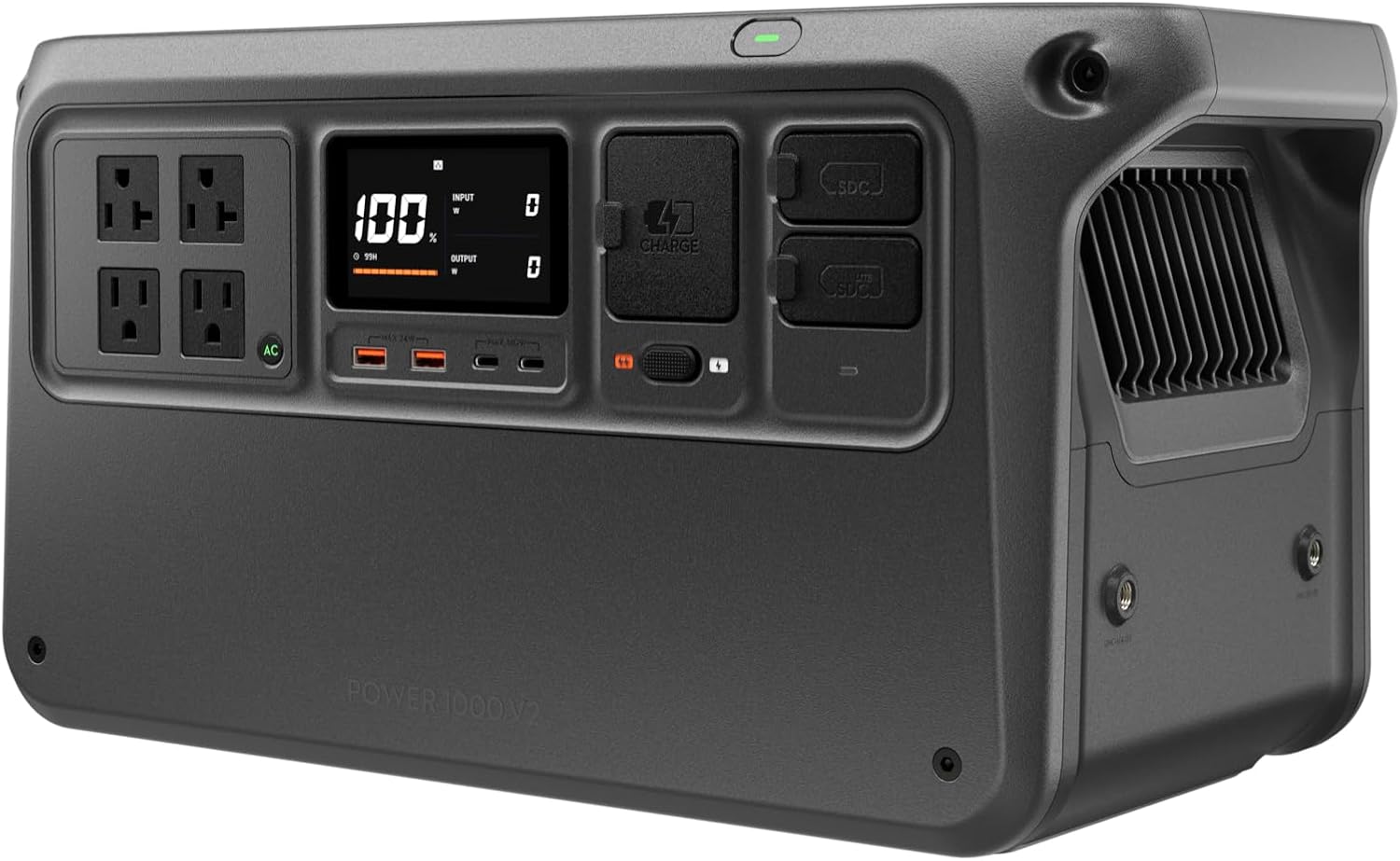
The DJI Power 1000 V2 is the refresh that fixes the original Power 1000’s two real shortcomings: native Wi-Fi is now built in (no firmware wait), and AC outlets jumped from 2 to 4. Everything else that made the original a credible challenger in the 1 kWh class — the segment-leading 1,200 W solar input ceiling, the 2,600 W AC output, the 56-minute recharge — carried forward, with a 400 W bump on continuous output.
This review covers where the V2 wins in the 1 kWh segment, where the Bluetti AC180 still beats it on price, and whether DJI’s now two-year-old portable power line is ready for first-time buyers.
What it is, in one sentence
A 1,024 Wh LFP power station with 2,600 W AC output, 1,200 W solar input ceiling, 56-minute wall recharge, native Wi-Fi monitoring, and 4 AC outlets — DJI’s second-generation answer to the EcoFlow Delta 2 and Bluetti AC180.
Specifications
| Spec | Power 1000 V2 DJI, $999 |
|---|---|
| Battery capacity | 1,024 Wh |
| Battery chemistry | LiFePO4 (LFP) |
| Cycle life to 80% | 4,000 cycles |
| AC continuous | 2,600 W |
| AC surge | 4,800 W |
| AC outlets | 4 (120 V, 20 A) |
| USB-A | 2 (standard) |
| USB-C PD | 2 (140 W max), 2 (65 W) |
| SDC fast charge (DJI proprietary) | 2 (for DJI drones / batteries) |
| Wall recharge time | 37 min to 80%, 56 min to 100% (1,440 W input) |
| Solar input max | 1,200 W |
| Solar recharge (1,200 W panels, full sun) | ~1.0 hour to 100% |
| Expansion batteries | Not supported (Power 2000 supports expansion) |
| Weight | 31 lb (14.3 kg) |
| Dimensions | 17 × 8.5 × 9.5 in |
| Warranty | 5 years |
| App control | Native Wi-Fi + Bluetooth (DJI Home app) |
Where it wins
1,200 W solar input on a 1 kWh battery
The Power 1000 V2’s 1,200 W solar input ceiling is 2.4× higher than the Bluetti AC180 (500 W) and the EcoFlow Delta 2 (500 W native, 1,000 W with $99 add-on). In real conditions, 1,200 W of panels produces 850-950 W of MPPT input through the day — enough to recharge the 1,024 Wh battery in roughly one hour of full sun, then continue delivering 800+ W directly to loads.
For RV solar arrays, cabin off-grid setups, or anyone running heavy daytime loads with rooftop panels, the V2 is the only 1 kWh-class unit that can fully use a residential-scale solar array.
2,600 W continuous beats the segment by 600 W
The V2’s 2,600 W AC output is the highest in the 1 kWh class — 600 W more than the Bluetti AC180 (1,800 W), 900 W more than the Jackery Explorer 1000 v2 (1,500 W), and 400 W more than the original Power 1000. That’s the difference between running a 1,500 W space heater + a 700 W toaster simultaneously vs picking one. 4,800 W surge handles compressor inrush on any home refrigerator comfortably.
Native Wi-Fi out of the box
The original Power 1000 launched without Wi-Fi support — Bluetooth only. DJI promised firmware Wi-Fi but it took most of a year to arrive. The V2 ships with native Wi-Fi from day one. Pair via Bluetooth, switch to Wi-Fi for remote monitoring, check state-of-charge from another room or while away. UI exposes per-port wattage, scheduled charging windows, and energy history.
4 AC outlets vs 2 on the original
The V1’s two AC outlets was a real port-flexibility gap for users running multiple appliances. The V2 doubles to 4 — enough to run fridge + Wi-Fi router + lamp + small appliance simultaneously without a power strip.
140 W USB-C and DJI drone fast charge
Two USB-C ports support 140 W PD output — full fast-charging speed for a 16-inch MacBook Pro. Two proprietary SDC ports fast-charge DJI Mavic, Air, and Inspire batteries 70% faster than standard USB-C. For DJI drone or camera owners, that’s a real ecosystem play.
Where it loses
$999 MSRP is segment-high
The Power 1000 V2 lists at $999 — $200 over the Bluetti AC180 and Jackery Explorer 1000 v2 at $799. Street pricing typically narrows the gap (V2 frequently $799 on sale, AC180 around $699), but at the same sale window the Bluetti gives you 12% more capacity (1,152 Wh vs 1,024 Wh) for $100 less. Pay the premium when the 1,200 W solar input matters; skip it when it doesn’t.
DJI’s portable power line is two years old
DJI launched portable power in mid-2024 with the original Power 1000. The V2 brings the line to less than two years old. EcoFlow has 4+ years of warranty-claim data; Bluetti and Jackery have 5+ years. DJI brand reputation in cameras and drones is excellent, but portable power is a different engineering problem (long-term cell management, BMS firmware reliability across thousands of cycles). The V2’s specs are competitive; the field reliability case is still being built.
No expansion battery support
If you outgrow 1,024 Wh, you’re buying a second unit. DJI’s expansion-ready model is the Power 2000 (2,048 Wh, expandable). The EcoFlow Delta 2 supports a 1,024 Wh expansion battery to 2,048 Wh total — the only unit in this class with an in-line growth path.
Limited US retail distribution
The V2 is sold direct from DJI and through Amazon, plus a small number of camera dealers. It’s not in most big-box stores. RMA goes through DJI’s standard channel — competent but slower than Anker’s industry-leading turnaround. Plan for 14-21 days for replacement units.
DJI Power 1000 V2 vs the alternatives
| Spec | Power 1000 V2 DJI, $999 | AC180 Bluetti, $799 | Explorer 1000 v2 Jackery, $799 |
|---|---|---|---|
| Capacity | 1,024 Wh | 1,152 Wh | 1,070 Wh |
| AC continuous | 2,600 W | 1,800 W | 1,500 W |
| AC surge | 4,800 W | ~2,000 W | 3,000 W (Power Lifting) |
| AC outlets | 4 | 4 | 3 |
| Chemistry | LFP | LFP | LFP |
| Cycles to 80% | 4,000 | 3,500 | 4,000 |
| Wall recharge to 100% | 56 min | 70 min | 60 min |
| Solar input max | 1,200 W | 500 W | 400 W |
| Weight | 31 lb | 37 lb | 23.8 lb |
| Native Wi-Fi app | Yes (V2) | Bluetooth only | Yes |
| Street price | ~$799 | ~$699 | ~$499 |
Who should buy it
- DJI drone and camera owners. Native SDC fast charge for Mavic/Air/Inspire batteries justifies the buy on its own.
- Solar-heavy users with 600+ W of panels. The 1,200 W input ceiling is the segment’s killer spec for off-grid daily cycling.
- Buyers running 1,800-2,600 W loads. The only sub-$1,000 unit in this class that runs a 2,000 W microwave + 500 W fridge simultaneously.
- 140 W USB-C charging households (16-inch MacBook Pros, multiple high-wattage laptops).
- Remote-monitoring users who want the native Wi-Fi the V1 lacked at launch.
Who should skip it
- First-time portable power buyers wanting the most field-proven incumbent. The Bluetti AC180 or Jackery Explorer 1000 v2 have years more reliability data and cost $200 less at MSRP.
- Buyers planning to grow into expansion. Buy the DJI Power 2000 instead, or the EcoFlow Delta 2 with a single expansion.
- Anyone shopping primarily on price-per-watt-hour. The Bluetti AC180 at $699 sale wins this comparison.
Frequently asked questions
DJI Power 1000 V2 FAQ
What's actually different between the Power 1000 V1 and V2?
Three real changes: AC output jumped from 2,200 W to 2,600 W; AC outlets doubled from 2 to 4; native Wi-Fi shipped from day one (V1 added Wi-Fi via firmware roughly 6 months after launch). Battery capacity (1,024 Wh), solar input (1,200 W), wall recharge time (56 min), weight (~31 lb), and SDC ports are essentially identical between versions. If you own the V1, the V2 upgrade is incremental, not generational.
Why does the Power 1000 V2 have such a high solar input ceiling?
DJI engineered the V2 with a higher-voltage MPPT controller (rated up to 60 V DC and 30 A) than competitors in the 1 kWh class. The trade-off is more expensive electronics, which is part of why the V2 lists at $999 vs $799 for the Bluetti AC180 and Jackery Explorer 1000 v2. For solar-heavy use the spec pays for itself; for grid-only backup, it's overspec'd.
Can the V2 fast-charge DJI drone batteries?
Yes. Two proprietary SDC (Smart Direct Charging) ports deliver up to 540 W per port to compatible DJI batteries. Charging time for a Mavic 3 Intelligent Flight Battery drops from 96 minutes (wall charger) to 56 minutes (V2 via SDC). The Inspire 3 TB51 battery charges from 0 to 80% in 35 minutes via SDC.
Is the V2 quiet enough for camping?
Yes. Fans run silently below 30% load. Under steady 1,000 W draw, fans operate at roughly 42 dB — quieter than a typical refrigerator. Above 1,800 W draw, fans ramp to ~52 dB, audible but not disruptive in a campsite environment.
What solar panels work with the Power 1000 V2?
Any panels with combined open-circuit voltage between 11 V and 60 V DC, total wattage up to 1,200 W. DJI's own Zignes 100 W solar panels are pre-terminated and ship with bundle discounts. Third-party panels from Renogy, Rich Solar, or Bougerv work via an XT60 adapter. For the full 1,200 W input, plan on 6× 200 W panels in a 3S2P (3 series, 2 parallel) configuration.
Bottom line
The DJI Power 1000 V2 is the best 1 kWh-class portable power station for solar-heavy use. The 1,200 W solar input ceiling and 2,600 W AC output are both class-leading by meaningful margins. The V2’s fixes (native Wi-Fi, 4 AC outlets) close the original’s two real software/port gaps without raising the price.
If you want the most field-proven incumbent at lower cost, the Bluetti AC180 or Jackery Explorer 1000 v2 are the safe picks. If you’re a DJI drone or camera user, the Power 1000 V2 pays back the premium in faster battery turnaround alone.
Editor’s rating: 4.5 / 5
Last reviewed: May 2026. Pricing accurate at last check; verify on merchant page.