Bluetti AC180 Review: The 1,152 Wh Value Pick for Backup and Camping
Bluetti AC180 review: 1,152 Wh LFP, 1,800 W output, 45-min fast recharge for ~$799. Where it beats the Jackery 1000 v2 and EcoFlow Delta 2 — and who should skip it.
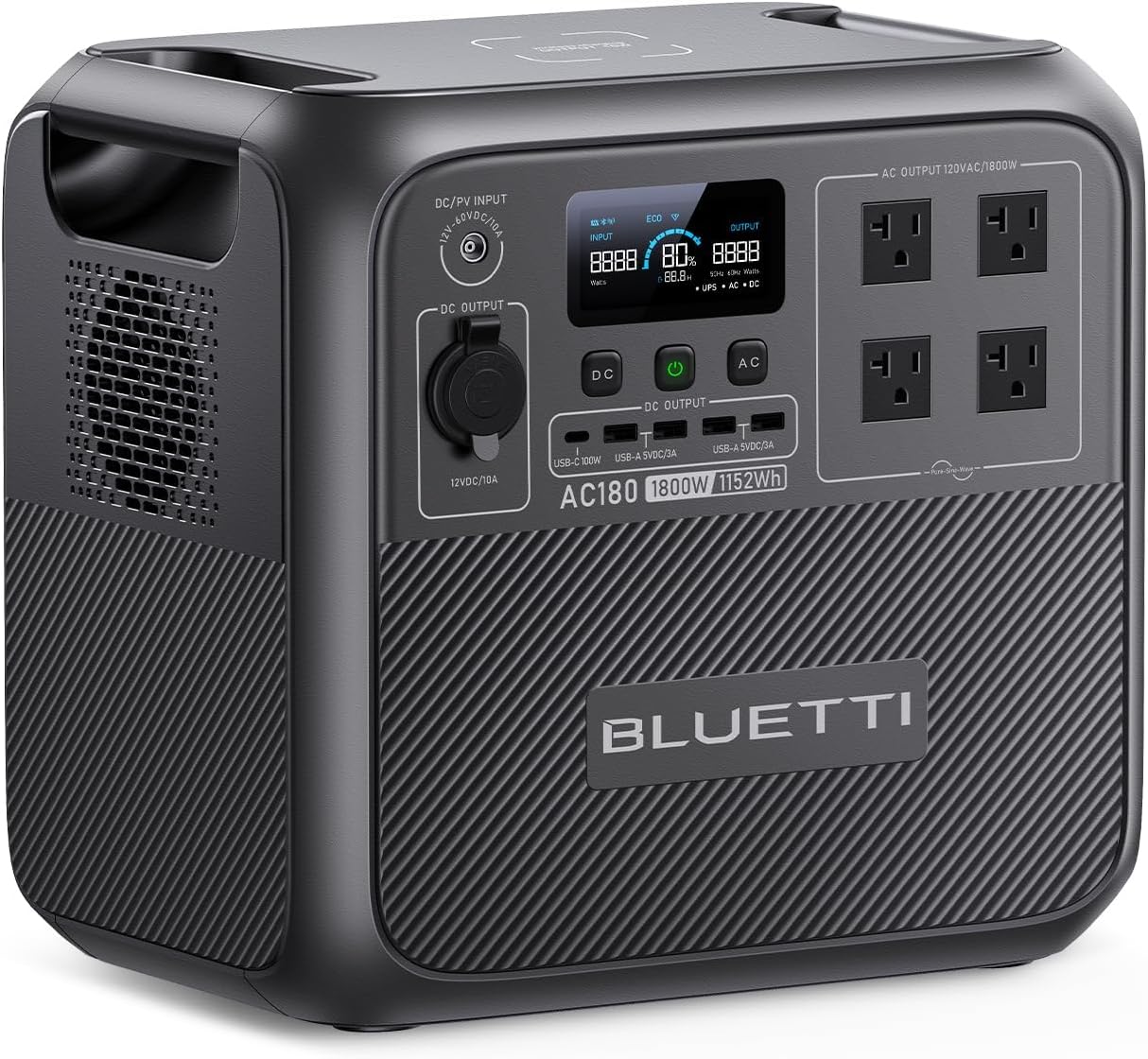
The Bluetti AC180 sits in the most contested slice of the portable power station market: the 1,000-1,200 Wh class with sub-$900 pricing. It went up against the Jackery Explorer 1000 v2 and EcoFlow Delta 2 the day it launched, and the spec that won the argument was capacity per dollar — 1,152 Wh of LFP for around $700-$800 street.
This review covers what the AC180 does well, where it falls short of the EcoFlow Delta 2, and whether it’s the right pick over the cheaper Jackery 1000 v2 or the step-up Bluetti AC200L.
What it is, in one sentence
A 1,152 Wh LFP power station with 1,800 W continuous AC output, 45-minute fast recharge, and a 3,500-cycle battery, sold for less per watt-hour than any other sub-$900 station with the same chemistry.
Specifications
| Spec | AC180 Bluetti, $799 |
|---|---|
| Battery capacity | 1,152 Wh |
| Battery chemistry | LiFePO4 (LFP) |
| Cycle life to 80% | 3,500 cycles |
| AC continuous | 1,800 W |
| AC surge / Power Lifting | 2,700 W resistive loads |
| 240 V split-phase | No |
| AC outlets | 4 (120 V, 20 A) |
| USB-A | 2 standard |
| USB-C PD | 1 (100 W) |
| 12 V cigarette | 1 (regulated, 10 A) |
| DC5521 | 2 |
| Wall recharge time (Turbo) | 45 min to 80%, ~70 min to 100% |
| Solar input max | 500 W |
| Solar recharge (500 W panels, full sun) | ~3.5 hours to 100% |
| Car recharge (12 V) | ~12 hours |
| Expansion batteries | Not supported |
| Weight | 37 lb (16.8 kg) |
| Dimensions | 13.4 × 9.7 × 12.6 in |
| Warranty | 5 years |
| App control | Bluetooth via Bluetti app |
Where it wins
Capacity per dollar in its class
At $799 MSRP and frequently $699 on sale, the AC180 delivers 1,152 Wh of LFP storage. The EcoFlow Delta 2 ships with 1,024 Wh at $999 MSRP. The Jackery Explorer 1000 v2 lands at 1,070 Wh for $799. The AC180 is the only one of the three that pairs the largest battery with the lowest sticker — usually $0.60-$0.70 per watt-hour at sale pricing.
LFP chemistry matters here too. All three use LFP, but the AC180’s 3,500-cycle rating to 80% capacity beats the Delta 2’s 3,000 cycles. At one full cycle a week (typical home-backup duty), that’s roughly 65 years of cycle life — calendar aging caps you long before you exhaust it, which is the point.
1,800 W continuous with Power Lifting headroom
The AC180’s 1,800 W continuous rating runs a 1,500 W space heater, a 1,200 W microwave, or a 1,000 W coffee maker without flinching. Power Lifting Mode pushes resistive loads up to 2,700 W by reducing voltage on heating elements — useful for a 2,400 W hair dryer or a 2,200 W heat gun, though it won’t help with motor-start surges on a sump pump or fridge compressor.
For motor-start loads (well pumps, fridges, AC compressors), trust the 1,800 W continuous spec and the un-published surge headroom (typically ~2,000-2,200 W instantaneous). Most apartment-grade fridges (~80-150 W steady, ~700-1,100 W startup surge) run fine.
45-minute fast recharge
Plug it into a 1,440 W wall outlet and the AC180 hits 80% in 45 minutes, 100% in about 70. That’s competitive with the EcoFlow Delta 2 (50 min to 80%) and miles ahead of the Jackery 1000 v2 (60 min to 80% via the proprietary fast adapter). For grid-tied backup, fast recharge is what lets you top up between outages or recover from an overnight discharge before you leave for work.
Quiet under partial load
The AC180’s fan is silent below ~30% draw and stays under 45 dB up to about 70% load. Compared to the Delta 2 (which ramps fans aggressively above 50%), the AC180 is the easier unit to leave running in a bedroom or living room during an outage. The Jackery 1000 v2 is similarly quiet — both Bluetti and Jackery have prioritized acoustics in this generation.
Where it loses
500 W solar input ceiling
This is the AC180’s biggest single limitation. With 500 W of panels and a Bluetti charge controller, expect 350-400 W of real-world MPPT input in full sun. That’s a 3-3.5 hour full recharge from solar — workable for a camping trip with a half-day of sun, marginal for an off-grid cabin during a stretch of cloudy weather.
The EcoFlow Delta 2 accepts 500 W out of the box and up to 1,000 W with a $99 extra charge controller. If you plan to lean on solar daily, the Delta 2 ecosystem scales further. The Jackery 1000 v2 caps at 400 W solar — the AC180 wins this one against Jackery.
37 lb is a real two-hand carry
Spec sheets call 37 lb portable. Anyone who has hauled a power station up basement stairs knows that’s a two-hand carry with regular rest stops on a long flight. The lighter EcoFlow Delta 2 (27 lb) and Jackery 1000 v2 (23.8 lb) are noticeably easier to move. If you’re putting the AC180 on a hand truck or leaving it in one room, this is a non-issue. If you camp every weekend, the 13-pound penalty over a Jackery 1000 v2 adds up.
Bluetooth-only app out of the box
The Bluetti app pairs over Bluetooth, which means you have to be within ~30 ft of the unit to check state-of-charge or kill a runaway load. Wi-Fi requires a separate sub-G hub accessory that isn’t bundled in the AC180 box. The EcoFlow app has had native Wi-Fi for years and lets you check status from anywhere with cell coverage — the kind of thing that matters at 2 AM when you wonder if the basement freezer is still running.
No expansion battery support
The AC180 is a closed system: what you buy is what you get. Bluetti’s expansion-ready models start at the AC200L ($1,499) and run up through the AC500 and AC300. If your power needs grow past 1,152 Wh, you’re buying a second unit, not bolting on a battery. The EcoFlow Delta 2 supports one extra battery to 2,048 Wh — a real consideration if you’re shopping with growth in mind.
Bluetti AC180 vs the alternatives
| Spec | AC180 Bluetti, $799 | Delta 2 EcoFlow, $999 | Explorer 1000 v2 Jackery, $799 |
|---|---|---|---|
| Capacity | 1,152 Wh | 1,024 Wh | 1,070 Wh |
| AC continuous | 1,800 W | 1,800 W (X-Boost 2,400 W) | 1,500 W |
| Chemistry | LFP | LFP | LFP |
| Cycles to 80% | 3,500 | 3,000 | 4,000 |
| Wall recharge to 80% | 45 min | 50 min | 60 min |
| Solar input max | 500 W | 500 W (1,000 W with add-on) | 400 W |
| Weight | 37 lb | 27 lb | 23.8 lb |
| Expansion battery | No | Yes (+1,024 Wh) | No |
| Wi-Fi app | Bluetooth only | Native Wi-Fi | Native Wi-Fi |
| Street price | ~$699 | ~$699 | ~$649 |
The straight read: the AC180 wins capacity, the Delta 2 wins ecosystem (solar expansion + extra battery + Wi-Fi app), the Jackery 1000 v2 wins portability and cycle life. Pick by which trade-off hurts least.
Who should buy it
- Apartment renters wanting maximum runtime per dollar. A 1,152 Wh battery powers a fridge for 12-15 hours, a Wi-Fi router for 30+ hours, or laptop + phone charging for a weekend. The AC180 delivers more of that for less money than the Delta 2.
- Weekend campers with an EcoFlow allergy. If you want a single-unit camping power station and you don’t want to deal with EcoFlow’s subscription-y software pushes, the AC180 is a quieter, lower-key choice.
- First-time portable power buyers who want LFP chemistry (not the cheaper NMC found in older models) without paying $1,000+. The AC180’s $699 sale price is the cheapest legitimate LFP entry point at this capacity.
Who should skip it
- Anyone planning to scale. No expansion battery support is a hard ceiling. Buy the Bluetti AC200L or the EcoFlow Delta 2 Max if you might want more capacity later.
- Off-grid daily-cycle users. 500 W solar input means slow recharge under cloudy conditions. The Delta 2 with the 1,000 W solar add-on is a better off-grid pick.
- Frequent campers carrying gear long distances. The Jackery Explorer 1000 v2 saves 13 lb for similar capacity and slightly better cycle life.
Frequently asked questions
Bluetti AC180 FAQ
Can the Bluetti AC180 run a refrigerator during a power outage?
Yes, comfortably. A typical full-size US refrigerator draws 80-150 W steady and surges to 700-1,100 W on compressor startup. The AC180's 1,800 W continuous and ~2,000 W instantaneous surge handles both. Expected runtime: 12-15 hours from a full charge, depending on fridge age and ambient temperature. Pair with a 200 W solar panel for indefinite daytime operation.
How does the Bluetti AC180 compare to the EcoFlow Delta 2?
The AC180 has 12% more battery (1,152 Wh vs 1,024 Wh) and recharges 5 minutes faster. The Delta 2 has X-Boost (virtual 2,400 W output by voltage reduction), supports an expansion battery to 2,048 Wh, and includes native Wi-Fi in the app. At equal sale pricing (~$699), pick the AC180 if you want maximum capacity today; pick the Delta 2 if you might add capacity later or need remote app monitoring.
What's the realistic solar recharge time?
With 500 W of panels in clean midday sun, expect 350-400 W of MPPT input (70-80% derating from spec). Full recharge from 0% takes 3-3.5 hours under those conditions. With 300 W of panels (a more common camping setup), expect 200-250 W of MPPT input and 5-6 hours to full. Cloudy conditions cut input by 50-70%.
Does the AC180 support pass-through charging?
Yes. You can charge devices off the AC180 while it's being recharged from a wall outlet or solar input. The battery's BMS prioritizes input over throughput, so a heavy AC load can slow battery recharge but won't interrupt powered devices.
What's the warranty and how does Bluetti handle RMAs?
5 years on the AC180 (battery and electronics). Bluetti's RMA process is mature but slower than Anker's — expect 7-14 business days for a return label and 2-3 weeks for a replacement unit if the original needs to ship to a service center. Keep your Amazon order email; Bluetti accepts proof of purchase from authorized resellers.
Bottom line
The Bluetti AC180 is the best value 1,000 Wh-class portable power station for buyers who want LFP chemistry, fast recharge, and the most capacity per dollar without scaling ambitions. At $699-$799 street, it undercuts the EcoFlow Delta 2 on capacity and matches it on output, with quieter operation and a longer-cycle battery.
If you might want to grow into expansion batteries, integrated home backup, or 1,000 W of solar input, spend the extra $300-$400 on the Bluetti AC200L or EcoFlow Delta 2 Max. If you want the lightest unit in this class for car camping, the Jackery Explorer 1000 v2 saves you 13 lb at similar runtime.
For everyone else — apartments, occasional outages, weekend trips, single-room backup — the AC180 is the rational pick.
Editor’s rating: 4.4 / 5
Last reviewed: May 2026. Pricing accurate at last check; verify on merchant page.