Bluetti AC200L Review: The 2,048 Wh Step-Up With Real Expansion Headroom
Bluetti AC200L review: 2,048 Wh LFP, 2,400 W output, expandable to 8,192 Wh, 60-min fast recharge. The honest middle-tier home backup pick versus the Delta 2 Max.
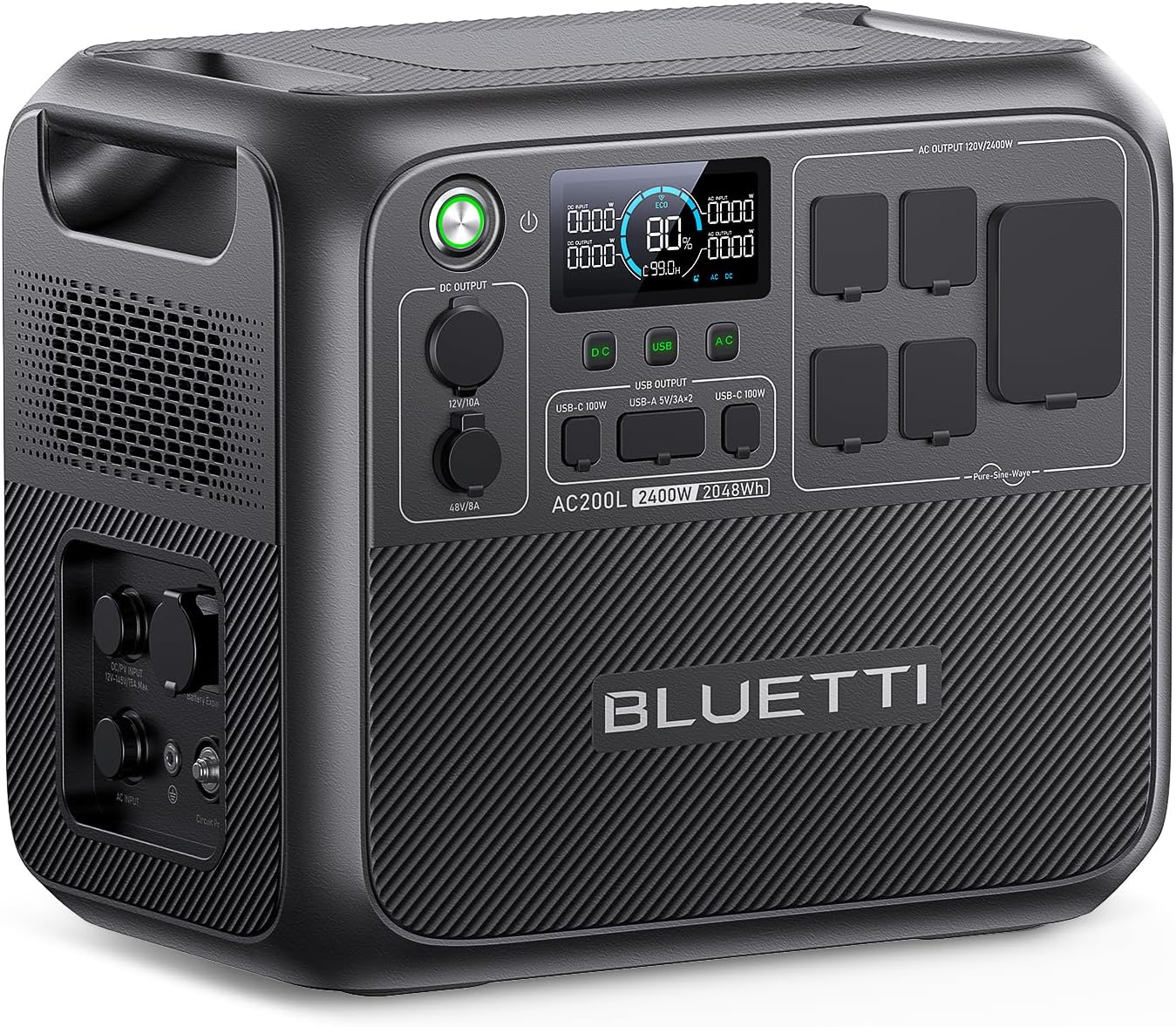
The Bluetti AC200L is the unit that bridges the gap between weekend-camping power stations and whole-home backup territory. At 2,048 Wh, 2,400 W output, and the ability to grow to 8,192 Wh with B300 expansion batteries, it’s the most flexible mid-tier choice on the market — and the one that finally fixed the 1,200 W solar input ceiling that made earlier Bluetti units painful for off-grid use.
This review covers the AC200L’s wins over the EcoFlow Delta 2 Max, where it falls short of the Anker SOLIX F3800, and whether it’s the right pick over the cheaper Bluetti AC180.
What it is, in one sentence
A 2,048 Wh LFP power station with 2,400 W continuous output, 1,200 W solar input, and modular expansion to 8,192 Wh — sized for the buyer who wants more than a camping unit but doesn’t need 240 V split-phase.
Specifications
| Spec | AC200L Bluetti, $1,499 |
|---|---|
| Battery capacity | 2,048 Wh |
| Max capacity (with expansion) | 8,192 Wh (with 2× B300) |
| Battery chemistry | LiFePO4 (LFP) |
| Cycle life to 80% | 3,500 cycles |
| AC continuous | 2,400 W |
| AC surge / Power Lifting | 3,600 W resistive loads |
| 240 V split-phase | No |
| AC outlets | 4 (120 V) + 1 NEMA TT-30 (30 A RV) |
| USB-A | 2 |
| USB-C PD | 2 (100 W) |
| 12 V cigarette | 1 (regulated, 10 A) |
| Wall recharge time (Turbo) | 60 min to 100% |
| Solar input max | 1,200 W |
| Solar recharge (1,200 W panels, full sun) | ~2.0 hours to 100% |
| Expansion batteries | B210 (2,150 Wh), B230 (2,048 Wh), B300 (3,072 Wh) |
| Weight | 62 lb (28.1 kg) |
| Dimensions | 16.5 × 11 × 14.4 in |
| Warranty | 5 years |
| App control | Bluetooth + Wi-Fi (native, no dongle) |
Where it wins
Real expansion path without buying a new unit
The AC200L pairs with up to two B300 expansion batteries (3,072 Wh each) for a total of 8,192 Wh. Add an inverter module or a transfer switch and you’ve got the start of a hardwired home backup system without committing to a fixed install. The EcoFlow Delta 2 Max caps at 6,144 Wh with two extras. The AC180 has zero expansion. For buyers who want to start at one battery and grow into multiple, the AC200L is the cleanest path in this tier.
1,200 W solar input fixes the old Bluetti weakness
Pre-AC200L Bluetti units capped at 500-900 W of solar. The AC200L doubles that ceiling. In real conditions, 1,200 W of panels produces 850-950 W of MPPT input through the day — enough to top up the 2,048 Wh battery in roughly 2-2.5 hours of full sun, or sustain steady appliance use entirely off solar during daylight. This is the spec that makes the AC200L viable for off-grid daily cycling, not just emergency standby.
60-minute Turbo recharge from a standard outlet
Plug it into a 1,800 W wall outlet and the AC200L hits 100% in roughly 60 minutes. The Delta 2 Max takes 81 minutes. The Jackery Explorer 2000 Plus takes 105 minutes via wall. For buyers using the AC200L as a grid-tied backup, fast recharge matters: you can top up between rolling blackouts or recover overnight without the unit being unavailable when the next outage hits.
Native Wi-Fi without an extra dongle
The AC200L app pairs over Bluetooth for setup and Wi-Fi for remote monitoring, with no separate sub-G hub required (the AC180’s biggest software gap). You can check state-of-charge, kill a runaway load, or schedule charging from anywhere with cell coverage. Bluetti’s app interface is denser than EcoFlow’s but exposes more controls.
Where it loses
62 lb is a basement install, not a road trip
The AC200L weighs 62 lb empty. Add a B300 expansion and the system grows past 130 lb without wheels. This is a one-time install: pick a spot in a basement, garage, or utility closet and don’t plan to move it. The Delta 2 Max (51 lb) and Jackery Explorer 2000 Plus (61.5 lb) are similar; if portability matters, look at the AC180 at 37 lb instead.
Expansion batteries are real money
Adding a single B300 expansion lifts capacity to 5,120 Wh — and adds $1,499 to the bill. Two extras pushes the system to ~$4,500 total, at which point you’re in the same price range as a single Anker SOLIX F3800 that includes 240 V split-phase. Map your end-state capacity before buying.
No 240 V split-phase output
The AC200L outputs single-phase 120 V only. If your backup plans include a well pump, central AC compressor, electric water heater, or EV Level 2 charger, you need a unit with 240 V split-phase. The Anker SOLIX F3800 is the single-unit option in this tier; the EcoFlow Delta Pro requires paired units plus a hub.
Bluetti AC200L vs the alternatives
| Spec | AC200L Bluetti, $1,499 | Delta 2 Max EcoFlow, $1,899 | Explorer 2000 Plus Jackery, $1,999 |
|---|---|---|---|
| Capacity | 2,048 Wh | 2,048 Wh | 2,042 Wh |
| Max expanded capacity | 8,192 Wh | 6,144 Wh | 24,000 Wh |
| AC continuous | 2,400 W | 2,400 W (X-Boost 3,100 W) | 3,000 W |
| Chemistry | LFP | LFP | LFP |
| Cycles to 80% | 3,500 | 3,000 | 4,000 |
| Wall recharge to 100% | 60 min | 81 min | 105 min |
| Solar input max | 1,200 W | 1,000 W | 1,400 W |
| Weight | 62 lb | 51 lb | 61.5 lb |
| Native Wi-Fi app | Yes | Yes | Yes |
| Street price | ~$999 | ~$1,099 | ~$1,399 |
Who should buy it
- Homeowners planning to grow into 5-8 kWh of capacity. The B300 expansion path is the cleanest in this segment.
- Off-grid cabin owners with 1,000+ W of solar. The 1,200 W input ceiling lets you run on solar daily, not just emergency standby.
- RV owners wanting a TT-30 30 A outlet for shore-power-style hookup without an adapter.
- Buyers who want fast recharge without buying a proprietary fast-charge brick (the AC200L hits 60 min from a standard 1,800 W outlet).
Who should skip it
- Anyone with 240 V loads (well pump, central AC, dryer, EV charger). Step up to the Anker SOLIX F3800 or pair two Delta Pros.
- Apartment-only buyers who don’t need expansion. The AC180 at $799 saves $700 and covers most single-room backup scenarios.
- Hardcore portability seekers. 62 lb stays where you put it.
Frequently asked questions
Bluetti AC200L FAQ
How does the AC200L compare to the EcoFlow Delta 2 Max?
Same battery capacity (2,048 Wh), same continuous output (2,400 W). The AC200L wins on solar input (1,200 W vs 1,000 W), wall recharge speed (60 min vs 81 min), max expansion capacity (8,192 Wh vs 6,144 Wh), and street price (~$999 vs ~$1,099 typical sale). The Delta 2 Max wins on weight (51 lb vs 62 lb), X-Boost virtual output (3,100 W on resistive loads), and EcoFlow's more polished app UX. Pick the AC200L for expansion ceiling and solar; pick the Delta 2 Max for portability and software polish.
Can the AC200L run a window AC unit overnight?
Yes. A typical 8,000 BTU window AC draws 600-800 W steady. The AC200L's 2,048 Wh battery delivers 2.5-3 hours of continuous AC operation, or all-night cycling if the AC runs intermittently (which most do). Pair with a 600 W solar input to extend daytime AC into a daily cycle.
What's the difference between the B210, B230, and B300 expansion batteries?
B210 is 2,150 Wh LFP at ~$1,099, B230 is 2,048 Wh LFP at ~$1,099, B300 is 3,072 Wh LFP at ~$1,499. The B300 has the best $/Wh ratio and is the recommended expansion if you're scaling. The AC200L supports up to two expansion units in any combination.
Does the AC200L include UPS pass-through for sensitive electronics?
Yes, with caveats. The AC200L provides a 20 ms switchover when grid power drops — fast enough for most desktops, NAS units, and home networking gear, but slower than a true online UPS (which has zero switchover). For medical equipment or servers that require uninterrupted power, pair the AC200L with a dedicated online UPS in series.
Is the AC200L worth the price over the AC180?
It depends on your end-state plans. At equal sale pricing ($999 AC200L vs $699 AC180), the AC200L delivers 78% more capacity, 33% more output, expansion support, 2.4× more solar input, and native Wi-Fi. The $300 premium is justified unless you're certain you'll never want more than 1,152 Wh, in which case the AC180 is the value pick.
Bottom line
The Bluetti AC200L is the best mid-tier expandable portable power station for 2026. It’s the unit you buy when you want to start with 2 kWh and have a credible path to 8 kWh, without paying the Anker SOLIX F3800 premium for 240 V split-phase you may not need.
If you want maximum capacity per dollar at the smaller end, the Bluetti AC180 is the value pick. If you want EcoFlow’s app ecosystem and X-Boost virtual output, the EcoFlow Delta 2 Max is the lateral. For everyone in the 2 kWh-with-growth-plans bracket, the AC200L is the rational pick.
Editor’s rating: 4.5 / 5
Last reviewed: May 2026. Pricing accurate at last check; verify on merchant page.