EcoFlow Delta 2 Max Review: The Software-First 2 kWh Power Station
EcoFlow Delta 2 Max review: 2,048 Wh LFP, 2,400 W output with 3,100 W X-Boost, 81-min recharge, and the best app in the segment. Where it beats the Bluetti AC200L and where it doesn't.
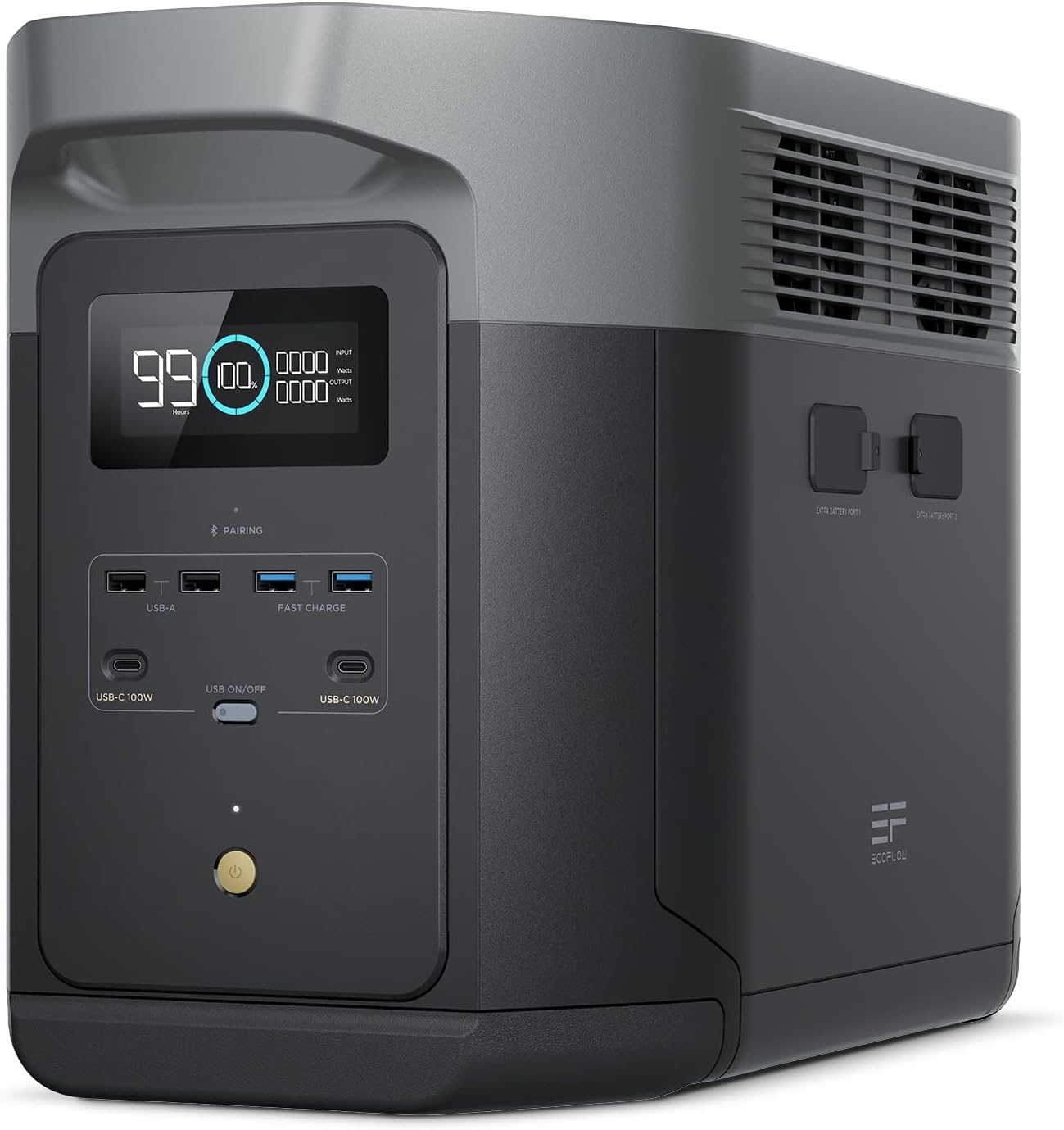
The EcoFlow Delta 2 Max is what happens when a company spends four years polishing power-station software while the competition catches up on hardware. The battery and inverter are class-competitive with the Bluetti AC200L; the difference is the app, the X-Boost mode, and the EcoFlow ecosystem you can opt into (Smart Home Panel, Whole Home Backup, smart plugs).
This review covers where the Delta 2 Max wins on software and weight, where the Bluetti AC200L takes the hardware match, and whether it’s worth $1,099-$1,499 street.
What it is, in one sentence
A 2,048 Wh LFP power station with 2,400 W continuous output, X-Boost virtual lifting to 3,100 W on resistive loads, expandable to 6,144 Wh, and the most polished app in the segment.
Specifications
| Spec | Delta 2 Max EcoFlow, $1,899 |
|---|---|
| Battery capacity | 2,048 Wh |
| Max capacity (with expansion) | 6,144 Wh (with 2× 2,048 Wh extras) |
| Battery chemistry | LiFePO4 (LFP) |
| Cycle life to 80% | 3,000 cycles |
| AC continuous | 2,400 W |
| X-Boost (resistive loads) | 3,100 W virtual output via voltage reduction |
| AC surge | 4,800 W |
| 240 V split-phase | No (single 120 V) |
| AC outlets | 6 (120 V) + 1 NEMA TT-30 (30 A RV) |
| USB-A | 2 standard + 2 fast charge |
| USB-C PD | 2 (100 W) |
| 12 V cigarette | 1 (regulated, 10 A) |
| Wall recharge time | 81 min to 100% |
| Solar input max | 1,000 W |
| Solar recharge (1,000 W, full sun) | ~2.5 hours to 100% |
| Expansion batteries | Up to 2× DELTA Max Smart Extra Battery |
| Weight | 51 lb (23 kg) |
| Dimensions | 19.7 × 9.4 × 12 in |
| Warranty | 5 years |
| App control | Native Wi-Fi + Bluetooth, automation rules, energy reports |
Where it wins
The app is the differentiator
EcoFlow’s app has had four years of iteration on Bluetti’s two and Anker SOLIX’s eighteen months. You get native Wi-Fi out of the box, remote monitoring from anywhere with cell coverage, scheduled charging windows (charge only during off-peak rates), AC output limits, and energy-history graphs. If you’ve ever managed a power station through Bluetooth only and had to walk to the basement to check state-of-charge, the EcoFlow app is the upgrade you didn’t know you needed.
The trade-off: the app pushes accessory upgrades and firmware nags more than competitors. You can ignore them.
X-Boost handles resistive surges Bluetti can’t
X-Boost is EcoFlow’s voltage-reduction trick for resistive loads. The Delta 2 Max’s 2,400 W rated inverter virtually outputs 3,100 W on hair dryers, kettles, space heaters, and other resistive loads by reducing voltage from 120 V to ~100 V. It doesn’t help with motor-start surges (compressors, pumps) — for those, trust the 4,800 W surge spec instead. The Bluetti AC200L’s Power Lifting Mode does the same trick at 3,600 W.
51 lb is class-leading
The Delta 2 Max weighs 51 lb. The Bluetti AC200L weighs 62 lb. The Jackery Explorer 2000 Plus weighs 61.5 lb. In the 2 kWh-class, the Delta 2 Max is the only unit you can carry up basement stairs without scheduling backup. The case has integrated side handles that actually work.
Single Multi Charge cable for 1,000 W solar
The Delta 2 Max accepts up to 1,000 W of solar input through a single Multi Charge cable — no extra MPPT module required (unlike older EcoFlow units that needed the optional 800 W extra). Plug your solar array into the included XT60 port and you’re done.
Where it loses
81-minute recharge lags Bluetti by a full 21 minutes
The Delta 2 Max takes 81 minutes for a full wall recharge. The Bluetti AC200L hits 100% in 60 minutes from the same 1,800 W input. For grid-tied backup buyers using the unit between rolling outages, 21 minutes of unavailability matters more than the spec sheet suggests.
1,000 W solar ceiling vs Bluetti’s 1,200 W
EcoFlow caps solar input at 1,000 W — 200 W less than the AC200L. In real conditions, that’s the difference between a 2.5-hour recharge and a 2-hour recharge on a sunny day. For off-grid daily-cycle use, the gap matters; for emergency backup, it doesn’t.
Expansion ceiling is 6,144 Wh, not 8,192 Wh
The Delta 2 Max supports up to two Smart Extra Batteries for a max capacity of 6,144 Wh. The Bluetti AC200L scales to 8,192 Wh with two B300 expansions. If your end state is 6 kWh or under, the Delta 2 Max is fine. If you might want more, the AC200L has more runway.
App push notifications get noisy
The EcoFlow app pushes accessory promotions, firmware updates, and energy-tip nudges more aggressively than Bluetti’s or Anker’s. Settings let you mute most of them, but the default state is loud.
EcoFlow Delta 2 Max vs the alternatives
| Spec | Delta 2 Max EcoFlow, $1,899 | AC200L Bluetti, $1,499 | Explorer 2000 Plus Jackery, $1,999 |
|---|---|---|---|
| Capacity | 2,048 Wh | 2,048 Wh | 2,042 Wh |
| AC continuous | 2,400 W (X-Boost 3,100 W) | 2,400 W (PL 3,600 W) | 3,000 W |
| Chemistry | LFP | LFP | LFP |
| Cycles to 80% | 3,000 | 3,500 | 4,000 |
| Wall recharge to 100% | 81 min | 60 min | 105 min |
| Solar input max | 1,000 W | 1,200 W | 1,400 W |
| Max expansion capacity | 6,144 Wh | 8,192 Wh | 24,000 Wh |
| Weight | 51 lb | 62 lb | 61.5 lb |
| App quality | Best | Good | Good |
| Street price | ~$1,099 | ~$999 | ~$1,399 |
Who should buy it
- Remote-monitoring buyers who want to check state-of-charge from work, schedule charging during off-peak hours, and run automation rules. EcoFlow’s app is the best in the segment.
- Apartment-to-house movers who value portability. 51 lb beats the 62-pound Bluetti by a meaningful margin.
- EcoFlow ecosystem adopters planning to add a Smart Home Panel or Whole Home Backup later. The Delta 2 Max integrates natively.
- Hair-dryer and space-heater households that benefit from X-Boost on resistive loads.
Who should skip it
- Off-grid daily-cycle users with 1,000+ W of solar. The Bluetti AC200L accepts 1,200 W and recharges faster.
- Buyers planning 6+ kWh of capacity. The 6,144 Wh ceiling caps your growth.
- 240 V split-phase needs. The Delta 2 Max is single-phase 120 V only. Step up to the Anker SOLIX F3800 or pair two Delta Pros.
Frequently asked questions
EcoFlow Delta 2 Max FAQ
What is X-Boost and when does it actually help?
X-Boost is EcoFlow's voltage-reduction mode for resistive loads. The Delta 2 Max's 2,400 W inverter virtually outputs up to 3,100 W on resistive devices (hair dryers, kettles, space heaters, electric kettles) by reducing voltage from 120 V to roughly 100 V. It works because resistive loads care about wattage delivered, not voltage. X-Boost does not help with motor-start surges (refrigerator compressors, well pumps, AC units) — those need true surge capacity, which the Delta 2 Max provides at 4,800 W.
How does the Delta 2 Max compare to the Delta Pro?
The Delta Pro has more capacity (3,600 Wh vs 2,048 Wh), more output (3,600 W vs 2,400 W), and supports 240 V split-phase when paired with the Double Voltage Hub. The Delta 2 Max is 51 lb vs the Delta Pro's 99 lb. Pick the Delta 2 Max for portability + single-circuit backup; pick the Delta Pro for hardwired loads or whole-home backup.
Can the Delta 2 Max replace a UPS for my desktop PC?
Yes for short outages. EPS mode provides 30 ms switchover when grid power drops — fast enough for most desktops, NAS units, and home networking gear, but slower than a true online UPS. For critical workloads, run the Delta 2 Max upstream of a small online UPS in series.
What solar panels work with the Delta 2 Max?
Any panels with combined open-circuit voltage between 11 V and 60 V DC, total wattage up to 1,000 W, and XT60 termination (or an XT60 adapter). EcoFlow's own 220 W panels are pre-terminated and ship with bundled discounts. Third-party panels from Renogy, Rich Solar, or HQST work fine with an XT60 adapter cable.
Is the Delta 2 Max worth the price over the original Delta 2?
Yes, if you need more than 1,024 Wh or expect to run loads above 1,800 W. The Delta 2 Max doubles capacity (2,048 vs 1,024 Wh), adds 600 W to continuous output (2,400 vs 1,800 W), and doubles max solar input (1,000 vs 500 W native). For single-room backup or weekend camping with light loads, the Delta 2 is still the value pick at half the price.
Bottom line
The EcoFlow Delta 2 Max is the best 2 kWh-class portable power station for software-first buyers. The app ecosystem, weight advantage, and X-Boost on resistive loads make it the right pick for apartment renters, weekend cabin users, and anyone planning to grow into the EcoFlow ecosystem (Smart Home Panel, Whole Home Backup).
If you’d rather have 21 fewer minutes of recharge time and 200 W more solar input, the Bluetti AC200L is the hardware pick at $300 less. If you need 240 V split-phase or whole-home backup, step up to the Anker SOLIX F3800.
Editor’s rating: 4.5 / 5
Last reviewed: May 2026. Pricing accurate at last check; verify on merchant page.