Jackery Explorer 1000 v2 Review: The Lightest Real 1 kWh Power Station
Jackery Explorer 1000 v2 review: 1,070 Wh LFP, 1,500 W output, 23.8 lb, 60-min fast recharge. The portability king under $800 — and where it loses to the Bluetti AC180.
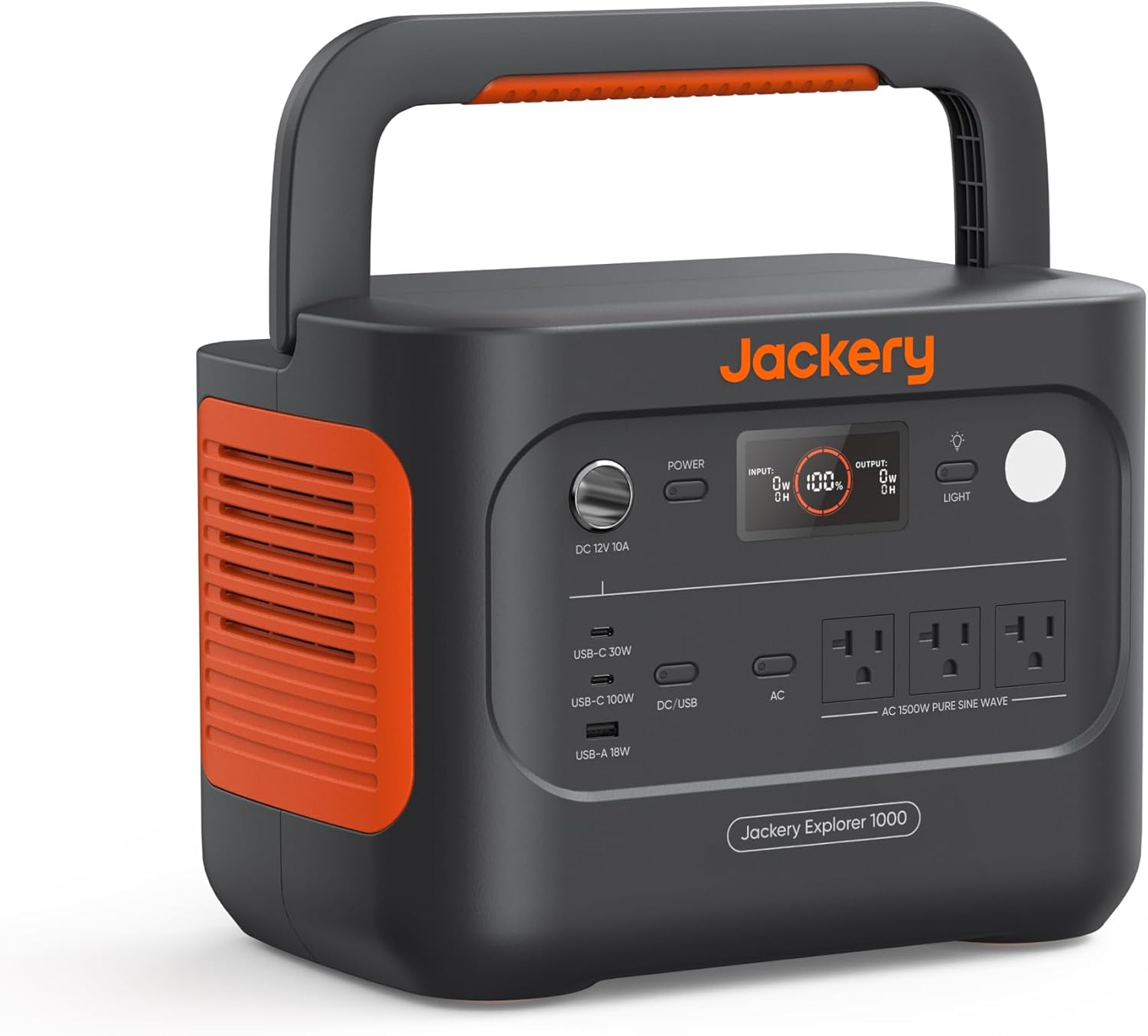
The Jackery Explorer 1000 v2 is the unit that finally answered the only honest knock against the Jackery brand: weight. The original Explorer 1000 was 22 lb but used older NMC chemistry with a 500-cycle battery. The v2 keeps the lightweight profile (23.8 lb) and swaps in LFP with a 4,000-cycle rating — the longest in the 1 kWh class.
This review covers where the Explorer 1000 v2 wins on portability and battery longevity, where it falls short of the Bluetti AC180 and EcoFlow Delta 2, and whether the 5-year Jackery warranty is worth a premium.
What it is, in one sentence
A 1,070 Wh LFP power station that weighs 23.8 lb, recharges to 100% in 60 minutes from a standard wall outlet, and is rated for 4,000 charge cycles — built for buyers who pick up and move their power.
Specifications
| Spec | Explorer 1000 v2 Jackery, $799 |
|---|---|
| Battery capacity | 1,070 Wh |
| Battery chemistry | LiFePO4 (LFP) |
| Cycle life to 80% | 4,000 cycles |
| AC continuous | 1,500 W |
| AC surge / Power Lifting | 3,000 W resistive loads |
| AC outlets | 3 (120 V, 15 A) |
| USB-A | 1 |
| USB-C PD | 2 (100 W) |
| 12 V cigarette | 1 (regulated, 10 A) |
| Wall recharge time (Turbo) | 60 min to 100% |
| Solar input max | 400 W |
| Solar recharge (400 W panels, full sun) | ~3.5 hours to 100% |
| Expansion batteries | Not supported |
| Weight | 23.8 lb (10.8 kg) |
| Dimensions | 12.4 × 8.8 × 9.8 in |
| Warranty | 5 years |
| App control | Native Wi-Fi + Bluetooth |
Where it wins
23.8 lb is the only real portability spec at 1 kWh
The Explorer 1000 v2 weighs 23.8 lb. The EcoFlow Delta 2 weighs 27 lb. The Bluetti AC180 weighs 37 lb. For weekly campers, tailgaters, or anyone packing the unit into and out of a vehicle regularly, the Jackery is the only one that doesn’t feel like work. The integrated top handle is bottle-grip thickness — one-hand carries are realistic for trips under 100 ft.
4,000 cycles is the longest in this class
The Explorer 1000 v2’s 4,000-cycle rating beats the AC180’s 3,500 and the Delta 2’s 3,000. Translated to use: at one full cycle per week, that’s 76 years of cycle life — far past the 12-15 year calendar-aging limit that caps any LFP battery. For daily-cycle off-grid use, the extra cycles matter; for weekly home backup, all three units outlast their useful service life.
60-minute Turbo recharge is class-leading speed
Plug it into a 1,400 W wall outlet and the Explorer 1000 v2 hits 100% in 60 minutes flat. The Bluetti AC180 takes 70 minutes. The EcoFlow Delta 2 takes ~80 minutes. For grid-tied backup and same-day camping prep, a one-hour recharge is the difference between leaving with a full battery and leaving with 70%.
Wi-Fi + Bluetooth app, both work out of the box
The Jackery app pairs over Bluetooth for setup and switches to Wi-Fi for remote monitoring without an additional dongle (the AC180’s biggest software gap). UI is clean, less cluttered than EcoFlow’s, exposes the essentials: state-of-charge, AC/USB output toggles, input source, scheduled charging windows.
Where it loses
1,500 W continuous trails the segment
The Explorer 1000 v2 caps continuous AC output at 1,500 W. The Bluetti AC180 delivers 1,800 W. The EcoFlow Delta 2 delivers 1,800 W (with X-Boost to 2,400 W on resistive loads). For most apartment-grade loads (fridge + Wi-Fi + lights + laptop), 1,500 W is plenty. For households running a microwave, electric kettle, or 1,500 W space heater alongside other loads, the output ceiling becomes a real constraint.
Power Lifting Mode raises virtual output to 3,000 W on pure resistive loads (kettles, space heaters, hair dryers) by reducing voltage, the same trick as EcoFlow’s X-Boost. It doesn’t help with motor-start surges.
1,070 Wh is the smallest capacity in the comparison
The Explorer 1000 v2’s 1,070 Wh battery is 7% smaller than the AC180’s 1,152 Wh and 4% larger than the Delta 2’s 1,024 Wh. For most users this is a wash, but if you’re using the unit to run a fridge overnight (~80-150 W steady), the 80 Wh advantage of the AC180 buys you about an extra hour of runtime.
400 W solar input is the lowest in class
The Explorer 1000 v2 caps solar input at 400 W. The Bluetti AC180 and EcoFlow Delta 2 both accept 500 W. In real conditions, 400 W of panels produces 280-320 W of MPPT input — a 4-hour recharge from empty under full sun. For weekend campers, that’s fine. For anyone planning to lean on solar daily, the AC180 or Delta 2 have more headroom.
No expansion battery support
Like the AC180, the Explorer 1000 v2 is a closed system. If you outgrow 1,070 Wh, you’re buying a second unit — Jackery’s expansion-capable models start at the Explorer 2000 Plus ($1,999). The EcoFlow Delta 2 supports a 1,024 Wh extra battery (to 2,048 Wh total) — the only unit in this class with a growth path.
Jackery Explorer 1000 v2 vs the alternatives
| Spec | Explorer 1000 v2 Jackery, $799 | AC180 Bluetti, $799 | Delta 2 EcoFlow, $999 |
|---|---|---|---|
| Capacity | 1,070 Wh | 1,152 Wh | 1,024 Wh |
| AC continuous | 1,500 W (PL 3,000 W) | 1,800 W (PL 2,700 W) | 1,800 W (X-Boost 2,400 W) |
| Chemistry | LFP | LFP | LFP |
| Cycles to 80% | 4,000 | 3,500 | 3,000 |
| Wall recharge to 100% | 60 min | 70 min | ~80 min |
| Solar input max | 400 W | 500 W | 500 W (1,000 W with add-on) |
| Weight | 23.8 lb | 37 lb | 27 lb |
| Expansion battery | No | No | Yes (+1,024 Wh) |
| Wi-Fi app | Native | Bluetooth only | Native |
| Street price | ~$499 | ~$699 | ~$699 |
Who should buy it
- Weekly campers, tailgaters, and overlanders who pack and unpack the unit constantly. The 13-pound weight savings over the AC180 is real over a season.
- Buyers who prioritize battery longevity for daily-cycle off-grid use. 4,000 cycles is the class leader.
- Brand-loyal Jackery buyers with existing Jackery solar panels (the SolarSaga line) and accessories.
- Anyone wanting the fastest recharge at 1 kWh — 60 minutes via Turbo is the class leader.
Who should skip it
- Households running 1,500-1,800 W loads. The AC180’s 1,800 W output covers more appliances simultaneously.
- Off-grid daily-cycle users with 500+ W of solar. The 400 W input ceiling is a real bottleneck.
- Buyers who might want to grow into expansion. The EcoFlow Delta 2 is the only one with a growth path in this class.
Frequently asked questions
Jackery Explorer 1000 v2 FAQ
How does the Jackery Explorer 1000 v2 compare to the original Explorer 1000?
The v2 swaps NMC chemistry (500 cycles) for LFP (4,000 cycles) — an 8× improvement in cycle life. AC output rises from 1,000 W to 1,500 W, and capacity rises slightly from 1,002 Wh to 1,070 Wh. Wall recharge time drops from 5.5 hours to 60 minutes. Weight stays virtually identical at 23.8 lb. The v2 is a complete generational upgrade; the original is end-of-life and should not be purchased new at any price.
Can the Explorer 1000 v2 run a residential CPAP overnight?
Yes, comfortably. A typical CPAP draws 30-60 W steady (humidifier off) or 60-100 W (humidifier on). The Explorer 1000 v2's 1,070 Wh battery delivers 17-35 hours of CPAP runtime depending on settings. Disable the humidifier and use a thermally insulated tubing to extend runtime to 25-30 hours per charge. For multi-night use, pair with a 200 W solar panel for daytime recharge.
What solar panels work with the Explorer 1000 v2?
Any panels with combined open-circuit voltage between 12 V and 50 V DC, total wattage up to 400 W, and Anderson PowerPole or DC8020 termination. Jackery's own SolarSaga 100 and 200 W panels are pre-terminated and bundle-discounted with the Explorer 1000 v2. Third-party panels work with a DC8020 adapter.
How loud is the Explorer 1000 v2 under load?
Silent below ~25% draw. Under steady 500 W load, fans run at roughly 42 dB — quieter than a typical refrigerator at 1 meter. Above 1,000 W draw, fans ramp to ~55 dB. Acceptable in a living room during an outage; noticeable in a tent.
Is Jackery's 5-year warranty actually 5 years?
Yes. Jackery's standard warranty is 3 years, extended to 5 years if you register the product within 14 days of purchase. Registration takes 2 minutes via the Jackery app. The RMA process is mature: Jackery covers shipping both ways for defective units within the warranty window, and turnaround typically runs 10-14 business days for replacement.
Bottom line
The Jackery Explorer 1000 v2 is the best portable 1 kWh-class power station for buyers who actually move the unit. The 23.8-pound weight is the only spec that makes a 1 kWh LFP station truly one-hand-grab portable, and the 4,000-cycle battery outlasts the segment.
If you want the largest battery in the class at the same price, the Bluetti AC180 gives you 7% more capacity and 300 W more output for 13 extra pounds. If you might want to grow past 1,070 Wh later, the EcoFlow Delta 2 supports a single expansion to 2,048 Wh. For everyone packing and unpacking weekly, the Jackery is the rational pick.
Editor’s rating: 4.4 / 5
Last reviewed: May 2026. Pricing accurate at last check; verify on merchant page.